Serendipity is such a beautiful word: it slides off the tongue with such ease and falls sweetly on the ear. It was serendipity when I used this service as an excuse to watch one of my favorite movies, "Places in the Heart," yet another time. I'm now such an experienced viewer of this movie that I get emotional and weepy before any action occurs. The movie opens with camera shots panning across the Texas prairie, moving from the countryside to town while a choir sings the hymn, Blessed Assurance. Even with my eyes closed it's no trick at all to follow the camera into the town of Waxahachie, Texas. The year is 1935; and Waxahachie, along with the rest of the nation, is mired in the Great Depression. It's Sunday, and although the camera lingers on the church, hinting at its centrality to this community, services are over and worshipers are leaving. In a succeeding series of vignettes we are visually introduced to the characters in our little drama as they piously say grace before Sunday dinner. Except for the family evicted from their home and living in their car, everything seems so peaceful and ordinary, but there's betrayal and mayhem to follow. When the story begins to unfold, the viewer is quickly inundated with a flurry of events: an adulterous tryst, the killing of the local sheriff, a lynching, two funerals, and a theft.
Before the viewer has a chance to recover from the shock of these opening events, the story zeros in on the sheriff's widow, Edna Spaulding. Widow Spaulding is soon visited by the local banker who reveals that her husband had mortgaged the farm and payment will be due shortly. When it appears that the widow does not have the means to make payment, the banker suggests selling out the farm and sending the widow's two children to live with relatives. The widow refuses and sets out to save her farm and her family. Family and home, these are the obvious places in her heart. The movie is actually more complex than just the struggle to save the old homestead. In another stroke of serendipity, I learned that Robert Benton, the writer and director of this movie, had said that the places he had in mind when he titled the movie were places he holds sacred in his own heart: Waxahachie, Texas where he grew up, memories and imaginings about friends and relatives, the little boy that he was, and events as seen through creative memory. Art imitates life in this case and Benton's themes: the sacred, place, and community are what I'd like to explore with you this morning. I hope that you will get some sense that these themes are not isolated from each other, but are interrelated in a complex way.
"The predisposition to religious belief," writes the sociobiologist, E. O. Wilson, "is the most complex and powerful force in the human mind and in all probability an ineradicable part of human nature." The evidence that Wilson cites for this statement, particularly the idea that religion is ineradicable, is anecdotal, but persuasive in my opinion. Religion in this context is of course a human social phenomenon. But what is it that moves individual humans to embrace religion? No doubt the answer to that question is complex, and I don't have a complete answer. But I would like to suggest that at least part of the answer lies in an individual's "sense of the sacred." The German theologian Rudolf Otto in his book, The Idea of the Holy, describes this kind of individual human experience when he writes,
"At one time or another in their lives most people encounter something truly extraordinary and overwhelming. They feel gripped by a reality that is 'wholly other' than themselves—something mysterious, awesome, powerful, and beautiful."
I leave it to you to decide if this wholly other reality is just that or more properly belongs to the realm of an induced sensation. One of the results of experiencing such sensations is that the person, place, or thing that caused the sensation or its surroundings may become regarded as sacred.
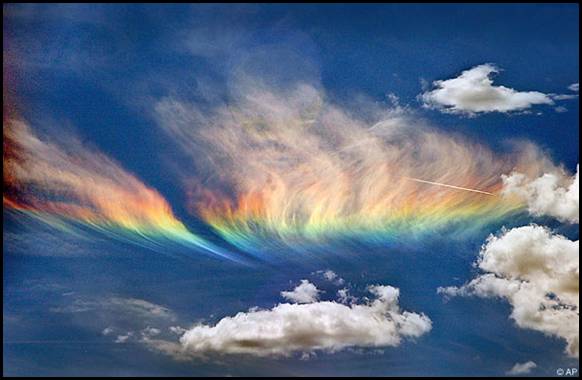
Let me just pose a little illustration of how this might work. Just suppose for a minute that you were walking on a nice day in a beautiful green valley, and you looked up to the sky and this is what you saw:
You might be so awe struck by this scene that you would leave thinking that this valley was extraordinary, "wholly other," sacred. Alternatively, suppose the day changed rapidly and when you looked up you saw this scene:
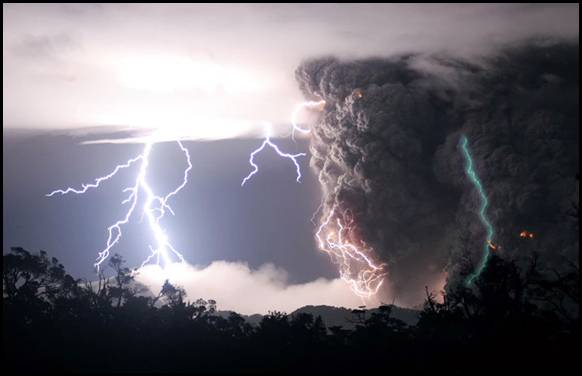
You might again leave the valley with the same awed feeling, but now you might also feel a tinge of fear. As a kind of theological thought experiment, you might imagine yourself to be a member of a prehistoric tribe that wanders into this valley, and ask yourself how the tribe's beliefs might be affected by these two scenes.
Our sense of the sacred is primitive and can be induced in many ways. I won't try to catalog them since place, whether naturally occurring or a cultural artifact, is our concern here. Naturally occurring places such as stones, caves, mountains, trees, and water must surely be among the most primitive stimulators of the human sense of the sacred. Human-constructed sacred places such as churches, mosques, synagogues, and temples conflate our individual sense of the sacred with a group or cultural expression of the sacred. Now I'm going to show you what are considered some of the most sacred structures in the world. An interesting aside to this little tour is that scholars think that many houses of worship are located in places that humans found naturally sacred.
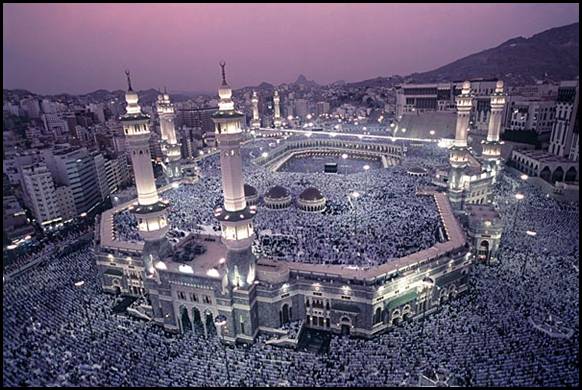
This is the Ka'ba Mecca and the al-Haram Mosque, the holiest site in Islam. The Ka'ba Mecca (the cubical structure within the mosque precincts) is believed by Muslims to have been built by Abraham and his son Ishmael. It also contains a sacred stone, the Black Stone, and is said to be the first place on earth that God created. The Black stone was revered in pre-Islamic times, and is an example of a house of worship being located in a place that humans found naturally sacred.
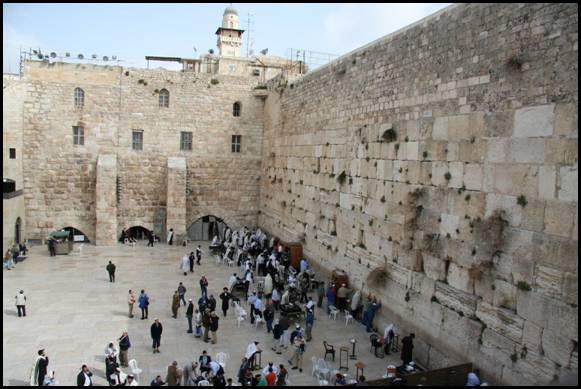
This is the Western Wall in Jerusalem, the holiest site in Judaism. The Western Wall is the only remaining part of Herod's Temple. The temple was the center of Jewish worship until it was destroyed by the Romans in the year 70 CE.
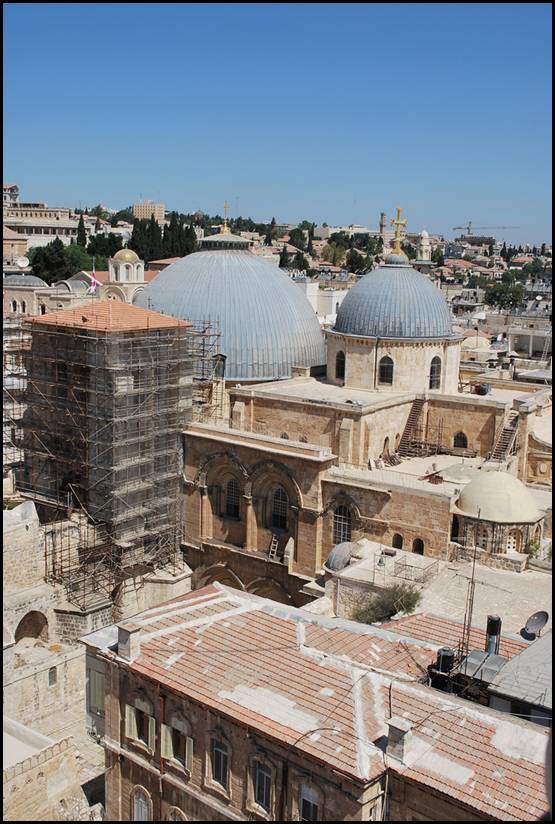
The Church of the Holy Sepulcher in Jerusalem is considered the most holy site in Christianity. It is built over the traditional site of the burial and resurrection of Jesus.
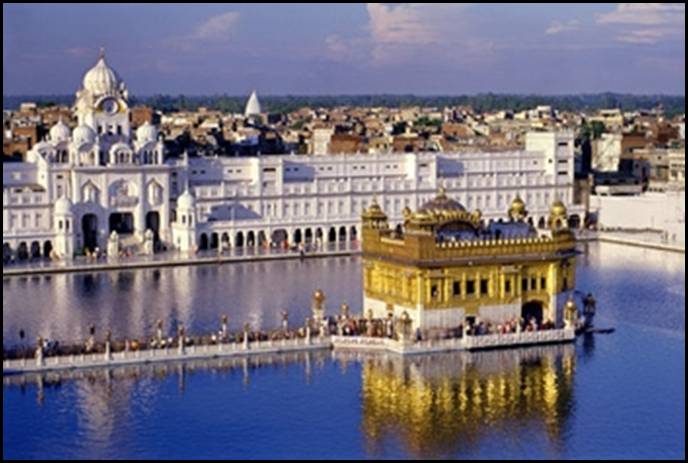
The Golden Temple in Amritsar India is the holiest site in Sikhism. The Golden Temple was built by the gurus and enshrines a holy book called the Guru Granth Sahib.
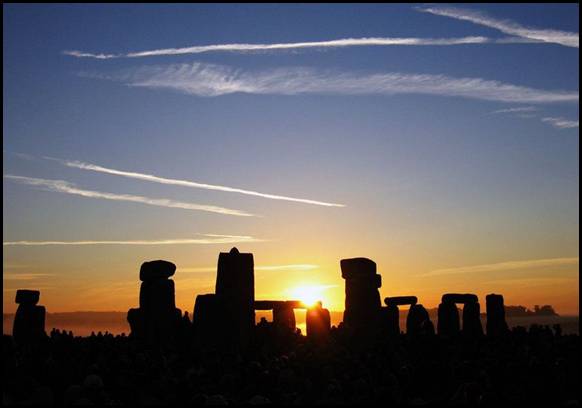
Here's the last stop on our little tour. This is Stonehenge in England. The photo was taken at sunrise on the summer solstice. Stonehenge is not on the list of the holiest religious sites since it is a sacred site that predates any known religion.
Viewing these photographs certainly heightens one's sense of what Wilson meant when he said that religion is the most complex and powerful force in the human mind.
Now, I'd like to show you just one more picture, a picture of a place in my heart.
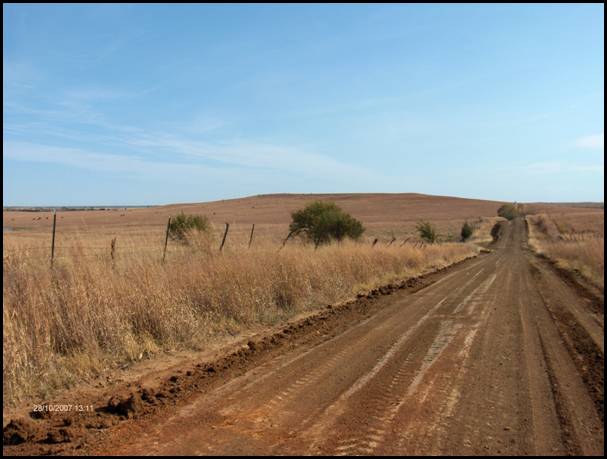
Doesn't look like much does it? But it's loaded with meaning for me. The scene is in Dickinson County Kansas. The road is 300 Avenue, and you are looking due east. If you look closely on the left between the third and fourth trees, you can probably make out Camp Road, which intersects 300 Avenue and runs due north. The land you are looking at on the left up to Camp Road was my Great-uncle William's homestead. He settled this land in the early 1870s. To the right just beyond Camp Road is the homestead of my Great-grandmother's parents. It was here that my great-grant parents first met. When they married they homesteaded a few miles north on Camp Road, and two more of my great grandfather's brothers also homesteaded off Camp Road. Through 1870s they all struggled to eke out a living from this land and keep their families intact. But the 1870s were terrible for farming in Kansas, and by the 1880s they had all lost their homesteads and moved on. Truly a place in my heart, a century and a quarter later I feel the loss of those homesteads, but I find some comfort in the words of poet Linda Gregg:
"I remember looking out the window and praising the beauty of the ordinary: the in-between places, the world with its back turned to us, the small neglected stations of our history."
It's time now to return to Widow Spaulding and her effort to save her homestead and family. With help from a black hobo, a blind man, and her children, Widow Spaulding triumphs by cotton farming. She brings in the first bale of cotton in the county and sells it at a price that allows her to pay the mortgage. Still, she faces an uncertain future since more mortgage payments are coming and the black hobo who was the guiding force behind her cotton farming has been run out of town by the Ku Klux Klan.
The final scenes in this movie are as surprising and shocking as the start. Again it's Sunday, only now we are inside the church for a service. The congregation is small and scattered. We hear just end of Blessed Assurance, and the preacher reads familiar words from 1 Corinthians, ending with, "... Love is patient, love is kind ... love does not end." Then as the communion service begins the choir sings In the Garden. As the communion wine is being passed, the congregation, as in gospel story of the miracle of the loaves and fishes, increases. The family that was living in their car and killed by a tornado is there, the black hobo is there, the sheriff is there, and the lynched black man who shot him is there. These people have wronged each other, and been wronged, grievously; but forgiveness, reconciliation, and love are in the room as one by one the congregants lift the communion wine to their lips and offer each other, "The Peace of God."
In a theological sense, perhaps Director Benton's intent is hinted at by the second line of Blessed Assurance, "O what a foretaste of glory divine!" In a more down-to-earth sense this ending seems to hold out a strong sense of the healing power of community, particularly religious community, in the face of all our human failings.
Having a connection with this religious community has had a powerful influence on my life. This Fellowship is a place in my heart, and I hope that it has a place in your hearts too. Next Tuesday will be the eighteenth anniversary of my joining this Fellowship. I've seen this community struggle to meet its mortgage, to keep this religious family together, and to keep the chalice of truth-seeking lit in dark times. And our struggle is not over. Our shared lives here, our commitment to each other and our principles, are what hallow this place and make it sacred. Can anyone doubt that where we stand this morning is holy, sacred ground? May we be ever mindful that this is so.
Copyright © 2009 Merrill Milham. All Rights Reserved.